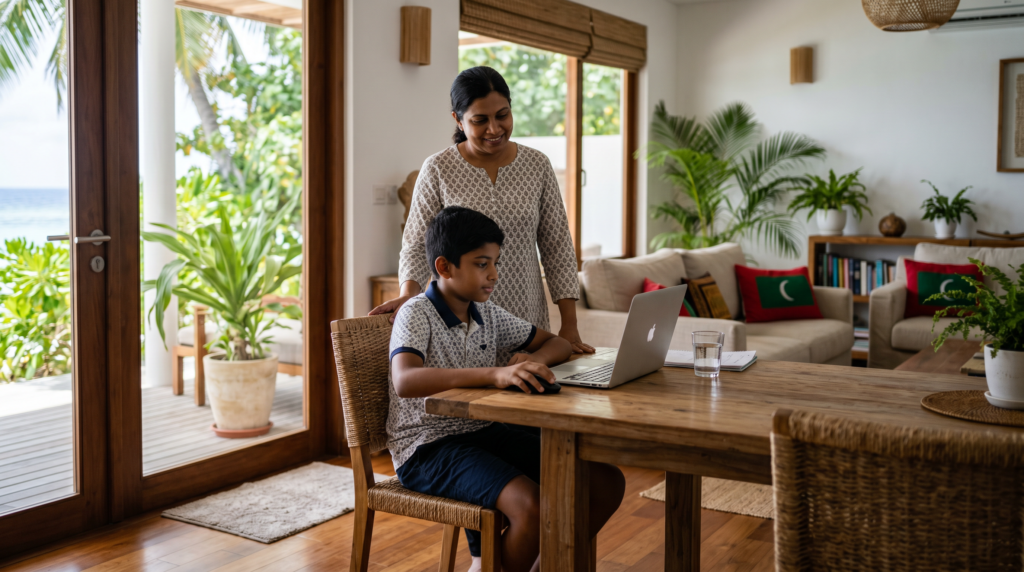
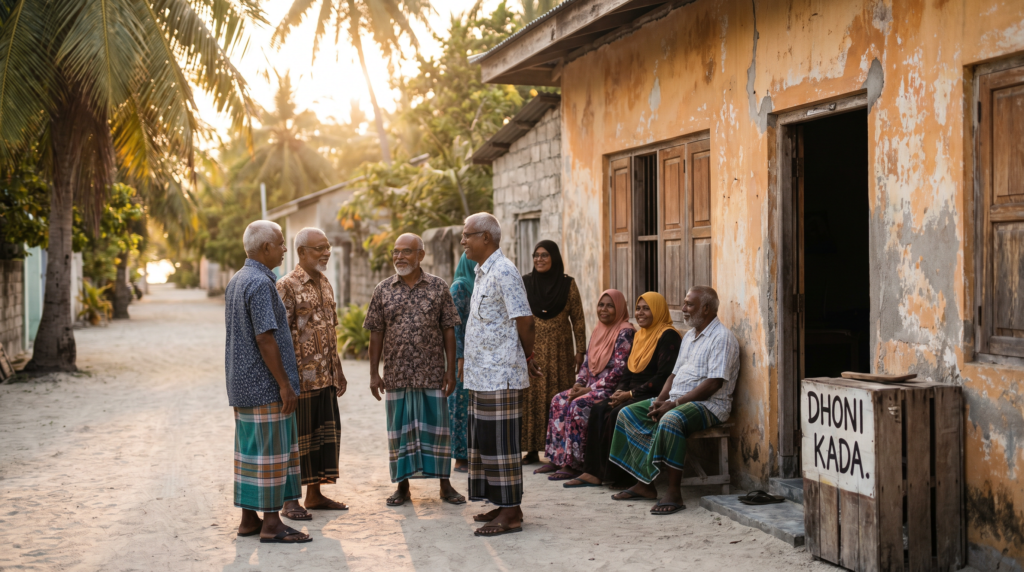
On many islands in the Maldives, the family home functions less like a private dwelling and more like a small ecosystem. Grandparents occupy one end, parents the middle rooms, children the shared spaces in between. Aunts arrive on weekends. Cousins sleep on mats during school holidays. Meals happen in shifts or all at once, in the courtyard when the evening is cool. This is multi-generational living — not as a trend or lifestyle choice, but as a lived, inherited way of being together.
According to data from the Maldives National University’s social research outputs and various housing surveys conducted in collaboration with the Ministry of National Planning, a significant proportion of island households outside Malé continue to house three or more generations under one roof. Even in Malé, where apartment living has fragmented the traditional family compound model, extended family networks remain among the most robust social structures in the country.
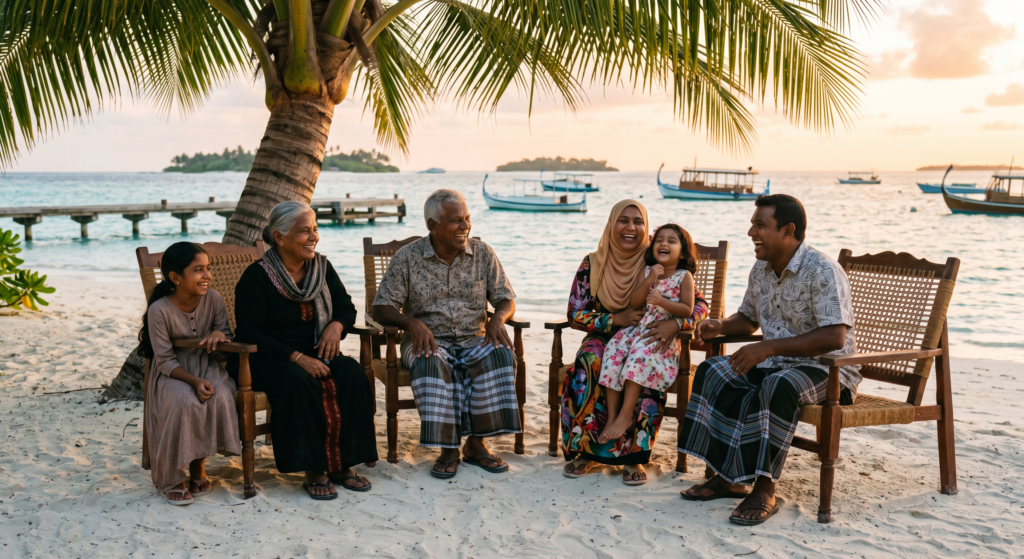
Why It Works: The Cultural Foundation
Multi-generational living in the Maldives is not simply a practical arrangement — it is an expression of Islamic values around silat ur-rahim (maintaining ties of kinship), Maldivian social norms around elder care, and a community-oriented worldview that views individual wellbeing as inseparable from family wellbeing.
For older generations, remaining in the family home provides not just physical care but meaning, relevance, and continuity. Grandparents in multi-generational households consistently describe a stronger sense of purpose than peers living alone. Research in gerontology published across multiple studies — including those conducted in comparable island community contexts in Southeast Asia — confirms that elderly individuals in extended family settings show lower rates of depression, better cognitive engagement, and, in many cases, improved physical health outcomes.
For children, the benefits are equally well-documented. Growing up in proximity to grandparents provides exposure to oral history, traditional skills, and a sustained model of aging that shapes values and perspectives in ways that nuclear family environments often cannot replicate. Children in multi-generational households frequently demonstrate stronger emotional regulation and more developed social competency — a finding linked by developmental psychologists to the greater diversity of adult relationships available to them.
The Real Challenges
Romanticizing multi-generational living without acknowledging its genuine difficulties does no one a service.
Space and privacy are among the most commonly cited tensions. In Malé, where housing density is among the highest in the world for an island city, physical proximity can transform personality differences into daily friction. Research on family stress in dense urban environments consistently identifies insufficient private space as a primary driver of household conflict across cultures.
Parenting disagreements between parents and grandparents are nearly universal in multi-generational households. Different views on discipline, screen time, diet, and education create tension that, if unaddressed, can become deeply corrosive to family relationships. A grandmother who feeds grandchildren sweets against parental rules is not acting maliciously — she is expressing love in the idiom she knows — but the effect on parental authority can be undermining.
Financial complexity arises when household contributions are uneven or undefined. Questions about who pays for utilities, food, household repairs, and elderly medical costs can go unspoken for years before surfacing as resentment. Many Maldivian families report that financial arrangements were never explicitly discussed — they evolved organically, which works during periods of goodwill but becomes fragile during hardship.
Caregiver burden, particularly when an elderly family member requires significant health-related care, disproportionately falls on women in the household. This is a documented pattern across South Asian family structures and is frequently underacknowledged in the Maldivian context.

Practical Strategies for Harmony
Define space explicitly. Even in modest homes, identifying certain spaces as belonging to specific family members or sub-units — the grandparents’ sitting room, the parents’ bedroom as genuinely private — reduces the psychological friction of always-shared living. Privacy is not selfishness; it is a basic psychological need.
Hold regular family meetings. Monthly conversations about household finances, roles, and any emerging tensions normalize discussion before issues compound. Families that make communication a routine — rather than reserving it for crisis — consistently report better long-term harmony. These meetings need not be formal; a shared meal with the explicit purpose of checking in is sufficient.
Negotiate grandparent roles clearly. Grandparents who understand the boundaries of their authority — loving, present, deeply influential, but not superseding parental decisions — thrive in multi-generational settings. Grandparents who are given (or assume) co-parenting authority without clarity create confusion for children and conflict between generations. The conversation is uncomfortable to begin but essential to have.
Protect the couple relationship. In the press of multi-generational life, intimate partnerships are often the first casualty. Couples who live in extended family households must make deliberate effort to protect time and space for their relationship. Research in family systems theory consistently identifies the couple as the structural center of the nuclear family — when that relationship weakens, the entire household becomes less stable.
Acknowledge and compensate caregiving labor. Whether through financial contribution, shared housekeeping, or explicit recognition and gratitude, the labor of those who provide primary care for elderly or young family members must be acknowledged. Invisible labor breeds invisible resentment.