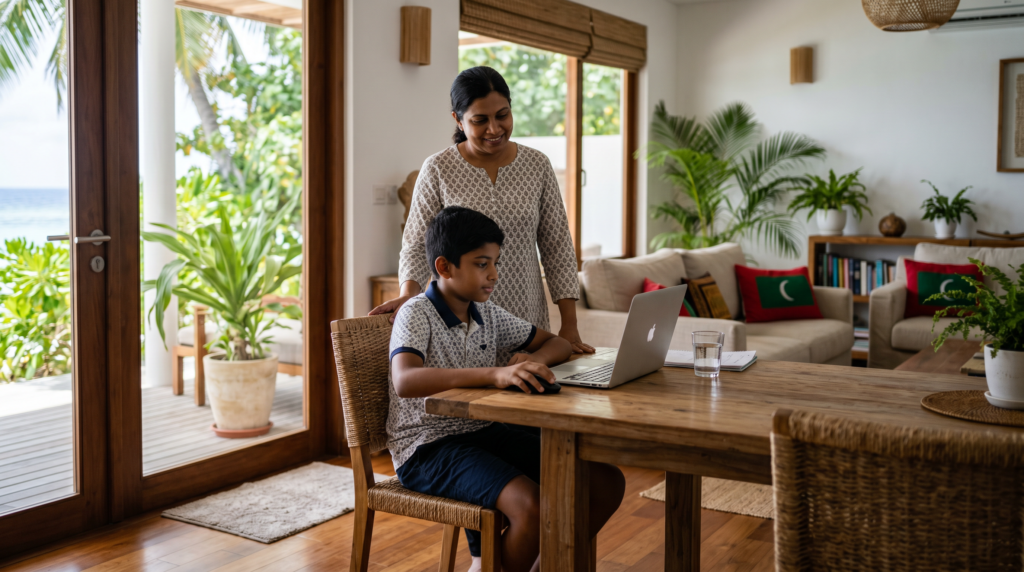
The Maldives has one of the highest mobile penetration rates in South Asia. According to figures from the Communications Authority of Maldives, the country’s active mobile subscriber count has consistently exceeded its total population, reflecting high rates of multi-device ownership. Broadband internet coverage has expanded significantly to inhabited islands, and social media usage among Maldivian youth tracks closely with global patterns — most teenagers are active on TikTok, YouTube, Instagram, and WhatsApp before they reach secondary school.
Technology brings undeniable benefits: connectivity across the archipelago’s dispersed islands, access to educational resources that were unavailable to previous generations, and participation in global culture and conversation. But it also brings real, documented risks that parents in the Maldives need to understand and actively address. This is not a reason to fear technology — it is a reason to engage with it knowledgeably.

Understanding the Real Risks
1. Inappropriate Content Exposure Search algorithms are imperfect, age gates on content platforms are easily circumvented, and social media platforms surface content based on engagement rather than suitability. Children as young as seven regularly encounter violent, sexual, or extremist content not through deliberate searching but through recommendation systems. The Internet Watch Foundation, which monitors online child safety globally, documents hundreds of thousands of child sexual abuse material incidents annually — a figure that reflects the scale of the problem, not its location.
2. Cyberbullying A 2022 UNICEF survey across South and Southeast Asia found that approximately 1 in 3 young people reported being bullied online. Cyberbullying differs from its offline equivalent in two critical dimensions: it follows children into their homes, removing the safe space that previously existed outside school, and it can involve audiences of hundreds or thousands rather than a small peer group. The psychological consequences are well-documented and include significantly elevated rates of anxiety, depression, and in severe cases, self-harm.
3. Excessive Screen Time and Sleep Disruption The American Academy of Pediatrics, the Royal College of Paediatrics and Child Health, and equivalent bodies across multiple countries have issued guidance on screen time, with particular concern about device use in the hour before sleep. Blue light from screens suppresses melatonin production, delaying sleep onset; the stimulating nature of social media and gaming content activates rather than relaxes the nervous system. Children who use devices immediately before bed consistently show measurably shorter sleep duration and poorer sleep quality.
4. Privacy Risks and Oversharing Children and adolescents routinely share personal information — location, school name, daily routines, physical appearance — across public or semi-public platforms without understanding the potential implications. This information can be used by malicious actors for targeted contact, manipulation, or in extreme cases, real-world harm.
5. Predatory Contact (Online Grooming) Online grooming — the systematic process by which malicious adults build trust with children to facilitate exploitation — occurs on every major platform, often using precisely the messaging apps that families rely on for communication. The Maldives’ strong community culture does not provide immunity; research indicates that grooming victims are not distinguished by demographic vulnerability but by the universal adolescent need for connection and validation.

A Family Digital Safety Framework
Rather than presenting digital safety as a list of prohibitions, families benefit from approaching it as an ongoing, evolving framework. The following structure is recommended by child online safety researchers and endorsed by organizations including the Internet Watch Foundation and UNICEF’s Office of Research:
Establish Technology Agreements, Not Just Rules Work with children — not unilaterally for them — to create a written family technology agreement. Include: which devices may be used where; screen-free times (meals, an hour before bed, first 30 minutes of the morning); which platforms require parental approval; what happens if someone online makes them uncomfortable. Children who participate in creating agreements are significantly more likely to observe them than children who receive rules from above.
Use Technical Controls as a Layer, Not a Solution Parental controls and content filters are valuable tools, but they are not sufficient on their own. Children consistently find workarounds; VPNs circumvent network-level filters; a friend’s unfiltered device is always accessible. Technical controls slow down exposure to harmful content and buy parents time — they do not replace communication and relationship.
Recommended free tools available in the Maldives:
- Google Family Link (Android and iOS): activity reports, screen time controls, app approval.
- Apple Screen Time (iOS): app limits, downtime scheduling, communication controls.
- Router-level DNS filtering (e.g., CleanBrowsing or Cloudflare for Families): blocks harmful content categories at the network level, covering all household devices.
Keep Devices in Shared Spaces The most consistent predictor of reduced online risk exposure in children is simple: device use in shared family spaces. When a child’s primary screen use happens in the living room, not their bedroom, parental visibility increases and the social inhibition around engaging with risky content provides a natural deterrent. This single change reduces problematic online behavior more reliably than most technical controls.
Create Open Communication Channels About Online Experience Children who have been told they will be punished for anything they encounter online are dramatically less likely to report something that disturbed them. Parents who explicitly de-couple disclosure from punishment — if anyone says something to you online that makes you feel weird, I want you to tell me and you will not be in trouble — create the conditions in which children actually seek help.
This conversation needs to happen before there is a problem. It needs to be revisited regularly, because children’s online environments change faster than most parents track.
Normalize Digital Literacy as a Family Practice Watch YouTube together and discuss how recommendations are generated. Examine an advertisement and talk about what it is trying to do. Ask a teenager to explain how an app works and listen without judgment. These interactions build children’s critical faculties and signal that you are a safe, knowledgeable person to turn to when something online goes wrong.
Resources Available in the Maldives
- Communications Authority of Maldives (CAM): provides regulatory guidance and has published consumer advisories on internet safety. Website: cam.gov.mv
- UNICEF Maldives: active programs on child protection, including digital dimensions. Website: unicef.org/maldives
- Internet Watch Foundation (IWF): global reporting mechanism for online child sexual abuse material. Website: iwf.org.uk
- Childline (where accessible via regional services): counseling and support for children facing online and offline threats.
Digital safety in the Maldives is not a specialized concern for technically sophisticated families — it is a basic parenting competency for the current era, as fundamental as teaching children to look before crossing a road. The technology itself is neutral; what shapes its effect on children is the engagement, awareness, and presence of the adults around them. That has always been true. It has never been more urgent.